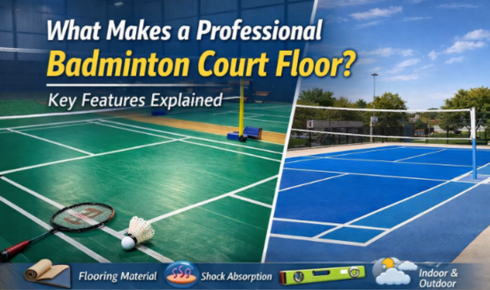
Badminton is a fast-paced sport that demands precision, agility, and safety. While skills and equipment play a role in performance, the importance of a professionally constructed badminton court flooring is often underestimated. From player movement to shuttle response, the playing surface directly influences the quality of the game. Understanding what makes a professional badminton court floor helps facility owners, institutions, and developers make informed decisions during badminton court construction.
This article explains the key features of a professional badminton court floor, covering badminton court flooring materials, dimensions, surface performance, and suitability for both indoor and outdoor badminton court construction.
Understanding Badminton Court Flooring Requirements
A professional badminton court flooring system is designed to support rapid footwork, sudden direction changes, and frequent jumps. Unlike recreational surfaces, professional floors are engineered to provide consistent grip, shock absorption, and durability. The goal is to create a surface that enhances performance while reducing the risk of injuries.
Badminton court flooring must meet standards defined by international and national sports bodies. These standards focus on surface uniformity, slip resistance, and player comfort rather than visual appearance alone.
Badminton Court Dimensions and Their Impact on Flooring Design
Correct badminton court dimensions are fundamental to professional play. A standard badminton court measures 13.4 meters in length and 6.1 meters in width for doubles matches, while singles courts are slightly narrower at 5.18 meters. Adequate run-off space around the court is also essential for safety.
Flooring design must align precisely with these dimensions to ensure accurate line marking and fair play. Any unevenness or incorrect layout can affect shuttle bounce perception and player movement. During badminton court construction, surface preparation and dimension accuracy go hand in hand to achieve professional standards.
Importance of Surface Uniformity and Leveling
One of the defining features of professional badminton court flooring is surface uniformity. The floor must be perfectly level, free from undulations, cracks, or inconsistencies. Even minor surface defects can disrupt player balance and increase the likelihood of injuries.
Proper base preparation is critical before applying the badminton court flooring material. A well-prepared sub-base ensures long-term performance and prevents premature surface failures. This step is especially important in outdoor badminton court construction, where environmental factors can affect the base layer.
Badminton Court Flooring Material: What Works Best?
Selecting the right badminton court flooring material is central to achieving professional quality. Different materials are used depending on whether the court is indoor or outdoor, budget considerations, and expected usage intensity.
Synthetic badminton court flooring has gained widespread acceptance due to its consistent performance characteristics. These systems are engineered to offer controlled friction, ensuring players can move confidently without slipping or excessive grip. Additionally, synthetic surfaces are designed to maintain performance across varying temperatures and usage conditions.
The flooring material should also provide adequate shock absorption. This reduces stress on players’ joints, particularly during jumps and lunges, which are common in badminton.
Synthetic Badminton Court Flooring and Performance Consistency
Synthetic badminton court flooring systems are known for delivering uniform playing conditions across the entire surface. Unlike traditional or improvised floors, synthetic systems are tested for slip resistance, wear resistance, and color stability.
Consistency is crucial in competitive environments. A professional court must perform the same in all zones, whether near the net or at the backcourt. Synthetic surfaces help achieve this consistency, making them a preferred choice in modern badminton court construction projects.
Another advantage is predictability. Players can trust the surface response, allowing them to focus on technique and strategy rather than adapting to flooring inconsistencies.
Shock Absorption and Player Safety
Player safety is a defining criterion of professional badminton court flooring. High-impact movements place significant stress on ankles, knees, and lower backs. A well-designed flooring system absorbs impact forces, reducing injury risks over long-term use.
Professional badminton courts are designed to balance cushioning and firmness. Excessively hard surfaces increase injury risk, while overly soft surfaces can affect movement speed and stability. Achieving this balance is one of the key objectives during badminton court construction.
Slip Resistance and Grip Control
Grip control is another essential feature of a professional badminton court floor. Players require enough traction to accelerate, decelerate, and change direction quickly. However, excessive grip can also be problematic, increasing the risk of joint strain.
Badminton court flooring materials are engineered to provide optimal slip resistance. This ensures controlled movement without compromising safety. In outdoor badminton court construction, slip resistance becomes even more critical due to exposure to moisture and changing weather conditions.
Indoor vs Outdoor Badminton Court Construction Considerations
Indoor and outdoor badminton courts have different flooring requirements. Indoor courts prioritize controlled environments, consistent lighting, and stable temperatures. Flooring materials used indoors focus on comfort, grip, and visual clarity.
Outdoor badminton court construction must address additional challenges such as UV exposure, rain, temperature fluctuations, and surface drainage. Flooring materials for outdoor courts are designed to withstand environmental stress while maintaining playability. Surface coatings and base preparation play a significant role in extending the lifespan of outdoor badminton court flooring.
Maintenance and Long-Term Durability
A professional badminton court floor is not only about initial performance but also long-term durability. Regular use, footwear friction, and environmental exposure can degrade low-quality surfaces quickly.
Synthetic badminton court flooring systems are generally easier to maintain and retain their performance characteristics over time. Proper cleaning routines and periodic inspections help preserve surface quality. During badminton court construction, selecting durable materials reduces lifecycle costs and ensures consistent playing conditions for years.
Visual Clarity and Line Markings
Clear and accurate line markings are an essential component of professional badminton court flooring. Lines must contrast clearly with the playing surface to ensure visibility during fast-paced rallies. Poor visibility can lead to disputes and disrupt gameplay.
The flooring system should allow precise line application that remains intact despite heavy usage. This is particularly important in multi-use facilities where badminton courts share space with other sports.
Role of Experienced Flooring Providers
Achieving professional standards requires technical expertise at every stage, from base preparation to surface finishing. Reputable providers with experience in badminton court construction understand these requirements and apply best practices accordingly.
Brands such as TopFlooring are often referenced in the sports infrastructure space for their involvement in synthetic badminton court flooring solutions and construction-focused applications. Experience in material selection, surface preparation, and installation contributes to achieving professional-grade outcomes.
Conclusion
A professional badminton court floor is defined by more than just appearance. It combines precise badminton court dimensions, carefully selected badminton court flooring material, surface uniformity, player safety, and long-term durability. Whether for indoor facilities or outdoor badminton court construction, attention to these key features ensures consistent performance and a safer playing environment.
As badminton continues to grow in popularity across institutions, clubs, and recreational spaces, understanding the fundamentals of professional badminton court flooring helps stakeholders make informed decisions. Well-planned badminton court construction ultimately supports better gameplay, reduced injuries, and longer-lasting sports infrastructure.