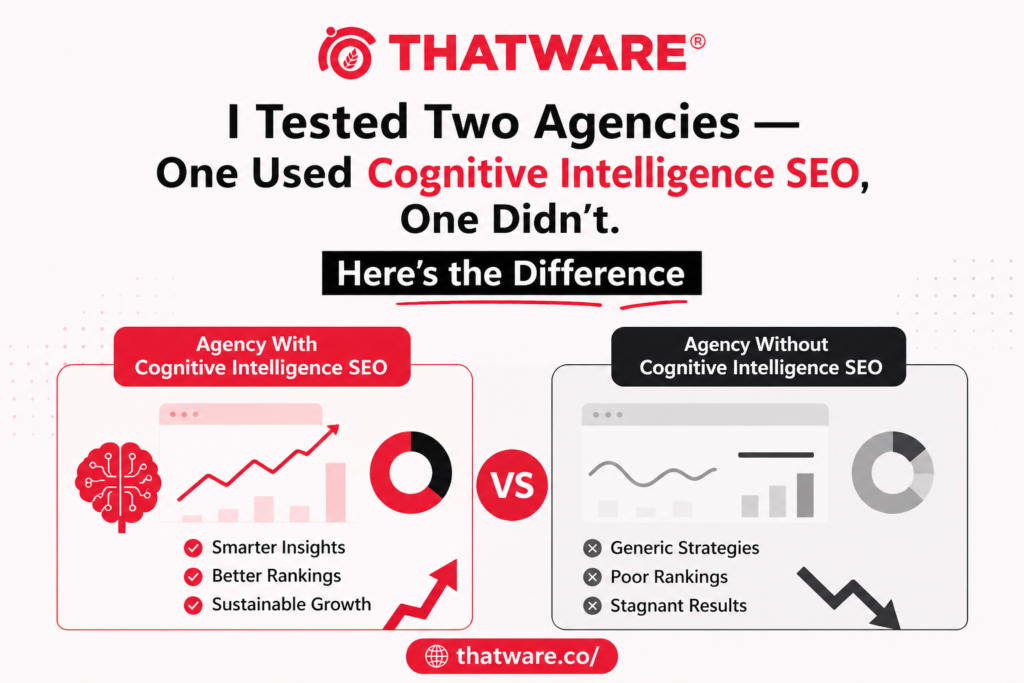
The setup for this comparison wasn’t designed as a controlled experiment. It emerged from a situation where I was managing two separate client accounts in different industries, both at roughly similar stages of their organic search development, who ended up working with very different agency approaches at roughly the same time.
One agency was running what I’d describe as well-executed conventional SEO: keyword research, quality content production, technical maintenance, legitimate link building. Good work, done properly. The other was applying what they called a cognitive intelligence framework to the same basic objectives: higher analytical depth at the strategy layer, behavioral signal monitoring integrated into content decisions, and predictive modeling applied to keyword and content prioritization.
Twelve months of watching both programs run produced observations worth sharing honestly.
The First Six Months: Not Much Difference
This is the part that any honest comparison needs to include. For the first six months, the two programs produced broadly similar results. Both achieved ranking improvements for priority keywords. Both grew organic traffic. Both made technical improvements that improved crawl health and page experience metrics.
If I’d evaluated both programs at the six-month mark, I might have concluded that the cognitive intelligence approach was producing roughly equivalent results to the conventional approach at higher cost, which wouldn’t have been a compelling case for the additional investment.
The divergence started appearing in month seven and became clearer through the end of the year.
Where the Divergence Appeared
The first place I noticed a difference was in ranking stability. The conventional approach produced ranking improvements that showed more volatility around algorithm updates. Positions improved, then softened, then recovered, in a pattern that’s typical for content primarily optimized for keyword signals without deep behavioral quality signals.
The cognitive intelligence program produced rankings that were more stable through the same algorithm update periods. Not immune to movement, but with less volatility and faster recovery when positions did shift. My interpretation is that the behavioral quality signals the program was building were creating more durable ranking foundations than keyword optimization alone.
Cognitive intelligence seo services work is building content quality at a level that’s harder to displace through algorithm changes that are specifically targeting manipulative or thin signals, because there’s less thin signal to target.
The Content Efficiency Difference
The second observable difference was in content efficiency. The conventional program was producing content at a set volume, a certain number of posts per month, and tracking performance post by post. Some performed well. Some didn’t. The optimization learning from underperforming content was limited.
The cognitive intelligence program was producing less content by volume but with more sophisticated pre-publication analysis of intent, audience calibration, and content structure. The hit rate, the percentage of published content that achieved meaningful ranking positions within ninety days, was noticeably higher.
Less content, performing better, is a better business outcome than more content with more variable performance. The volume of content isn’t the point. The efficiency of content investment is.
The Predictive Element
The most interesting difference, and the hardest to evaluate objectively, was in forward-looking strategy. The conventional program adjusted strategy based on performance data from work already done. The cognitive intelligence program incorporated predictive modeling about keyword opportunity trends, adjusting content investment toward clusters that analysis suggested were growing in search demand before that growth became visible in volume tools.
By the end of the year, several content investments made in month three and four based on this predictive analysis were paying off in rankings for keyword clusters that had noticeably grown in competitive value. The conventional program wasn’t wrong about those clusters. It just identified them later.
Cognitive ai seo services that incorporate predictive modeling are making bets that take months to validate. But when the bets are based on sound analytical frameworks rather than intuition, they tend to pay off in ways that make the early investment look prescient in retrospect.
What I’d Do Differently
Given twelve months of observation, would I recommend the cognitive intelligence approach universally? No, with explanation.
For clients with ample budget, high competitive pressure, and content programs that are mature enough to benefit from sophisticated analysis, the additional investment in cognitive intelligence approaches produces visible returns over a twelve-month-plus horizon. The compounding quality signals and improved content efficiency justify the higher cost at scale.
For clients with limited budgets, early-stage organic programs, or categories where conventional SEO hasn’t been properly executed yet, starting with cognitive intelligence approaches is premature. Get the conventional fundamentals right first. The sophisticated analytical layer produces the most value when it’s built on a solid foundation, not when it’s being applied to fix basic execution problems.
The comparison was instructive not because it declared a clear winner but because it revealed where each approach produces its strongest returns. Knowing the difference helps make better decisions about which to apply in which situation.